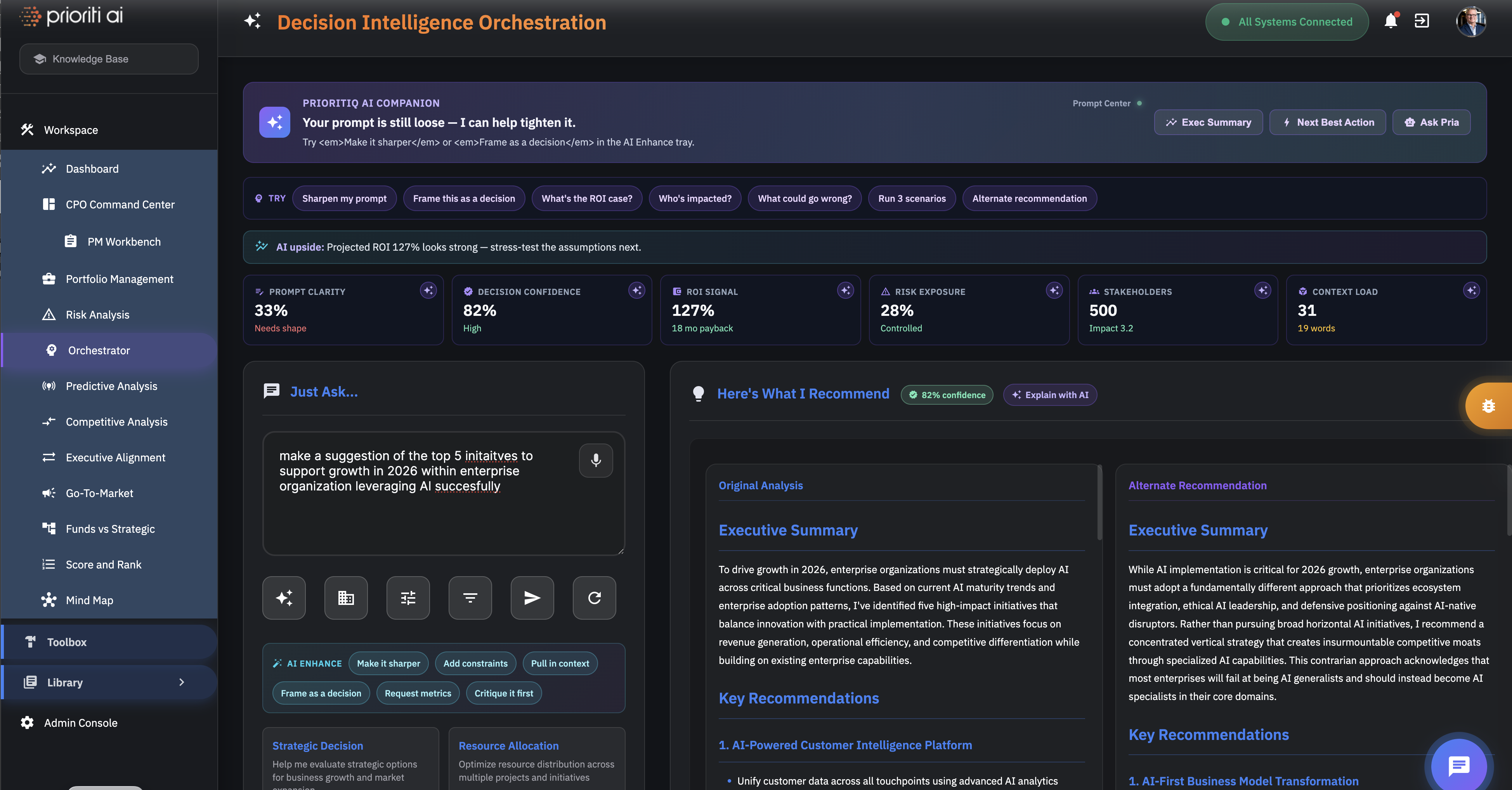
Decision intelligence
Orchestrator
AI-powered prompt orchestration and decision intelligence center with multi-agent analysis, KPIs, and executive-ready briefings.
See it in the platformResources
Everything I’ve published on agentic AI and decision intelligence. The customer experience and innovation craft is less written down and more practiced — it shows up in the frameworks and tools below, and in the engagements.
Latest: The Intelligence Economy — From Attention to Judgment · Previous paper
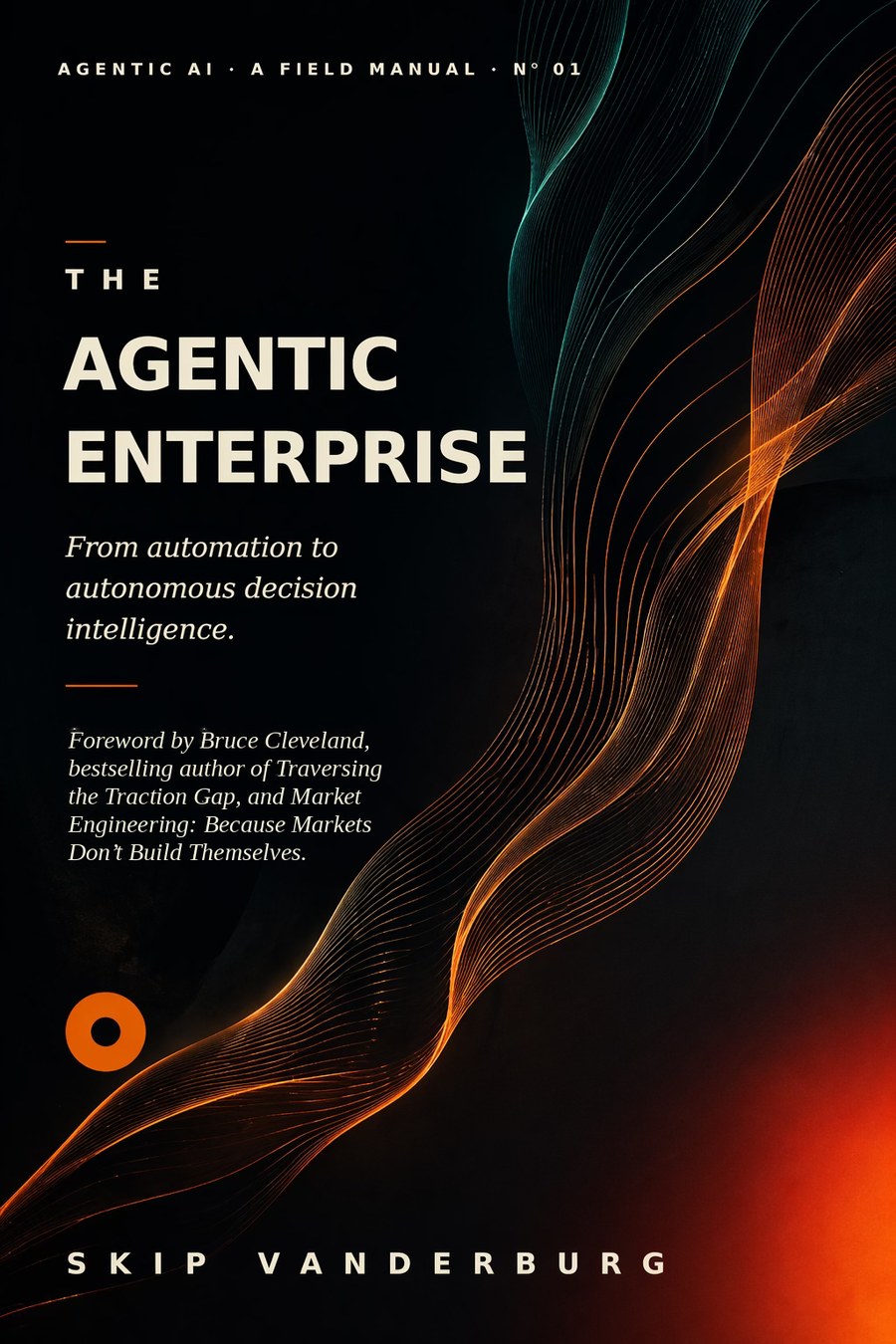
From automation to autonomous decision intelligence.
The enterprise no longer competes on what it automates. It competes on how it decides.
A field manual for leaders building enterprises where AI is no longer a feature inside a workflow but the decision-making fabric across the business — sensing, reasoning, prioritizing, acting. The bottleneck is no longer information. It is the decision-making process itself.
From periodic planning → always-on intelligence
From human coordination → agent-driven execution
From static ranking → adaptive intelligence
Foreword by Bruce Cleveland, bestselling author of Traversing the Traction Gap and Market Engineering: Because Markets Don't Build Themselves.
Written for CEOs, COOs, and boards · CIOs, CTOs, and CDAOs · strategy and transformation leads · product and engineering leaders
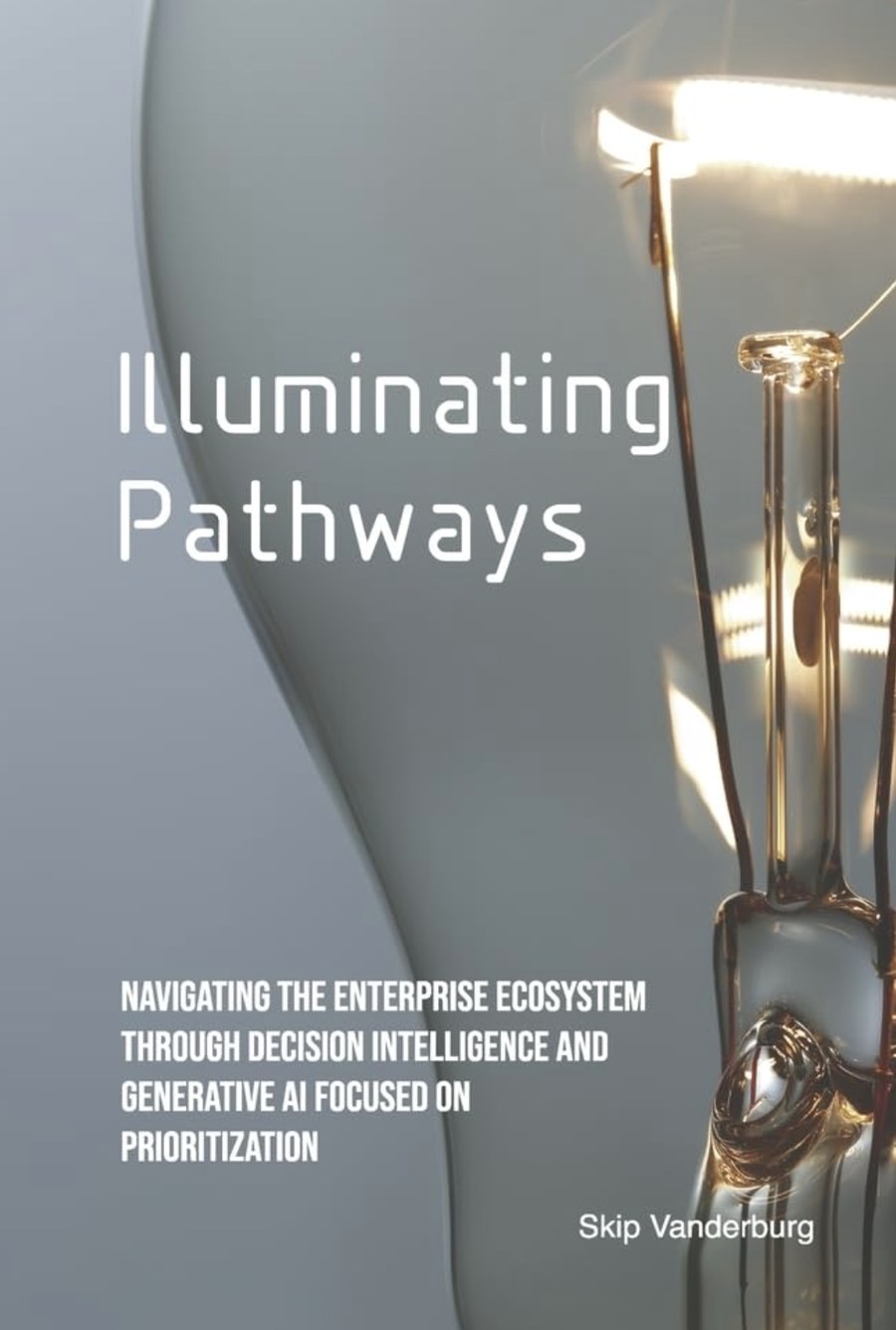
Navigating the enterprise ecosystem through decision intelligence and generative AI, focused on prioritization.
“Illuminating Pathways” is required reading for any business executive who wants their company to remain viable. Bruce Cleveland · from the foreword
Business intelligence gave executives hindsight — charts about what already happened, with a human left to find the opportunity inside them. Decision intelligence is built the other way around. The playbook for that shift: how generative AI assesses, scores, and prioritizes initiatives, what it takes to run, and where the traps sit.
Written to be jumped around in. Read it cover to cover, or go straight to the chapter, industry, or scorecard you need.
What decision intelligence changes, and where generative AI actually helps
Foundations, infrastructure, applied decision-making, and industry-by-industry use
Starting the journey, readying the organization, and measuring whether it worked
Foreword by Bruce Cleveland — technology executive, venture capitalist, author — on decision intelligence arriving as a software category on a genuinely new stack.
Case studies across insurance, healthcare, pharmaceutical, ESG, financial services, CPG, and retail.
A retrospective and prospective view.
Enter Decision Intelligence — the next generation of decision-making frameworks designed to harness the power of artificial intelligence to optimize choices, strategies, and outcomes. From the introduction
Two views of the same discipline. Back: how enterprises got from 1960s batch reporting through data warehousing, OLAP, and business intelligence — and why those systems could still only describe what had already happened. Forward: what changes when AI stops supporting decisions and starts driving them.
The turn is traced to four developments at once — exponential data growth, cloud and big data, demand for real-time decisions, and the proliferation of machine learning. Decision intelligence is what gets built on top: proactive, context-aware, answerable to an outcome rather than a dashboard.
From mainframe reporting to warehouses, OLAP, and the limits of descriptive insight
Data growth, cloud and big data, real-time demand, and the arrival of AI and ML
AI that drives decisions across business, government, healthcare, and beyond
Opens with The Dawn of a New Decision-Making Era — decision-making traced from intuition to systems that analyze, interpret, and recommend beyond human scale.
Written for leaders making the transition in business, government, healthcare, and beyond.
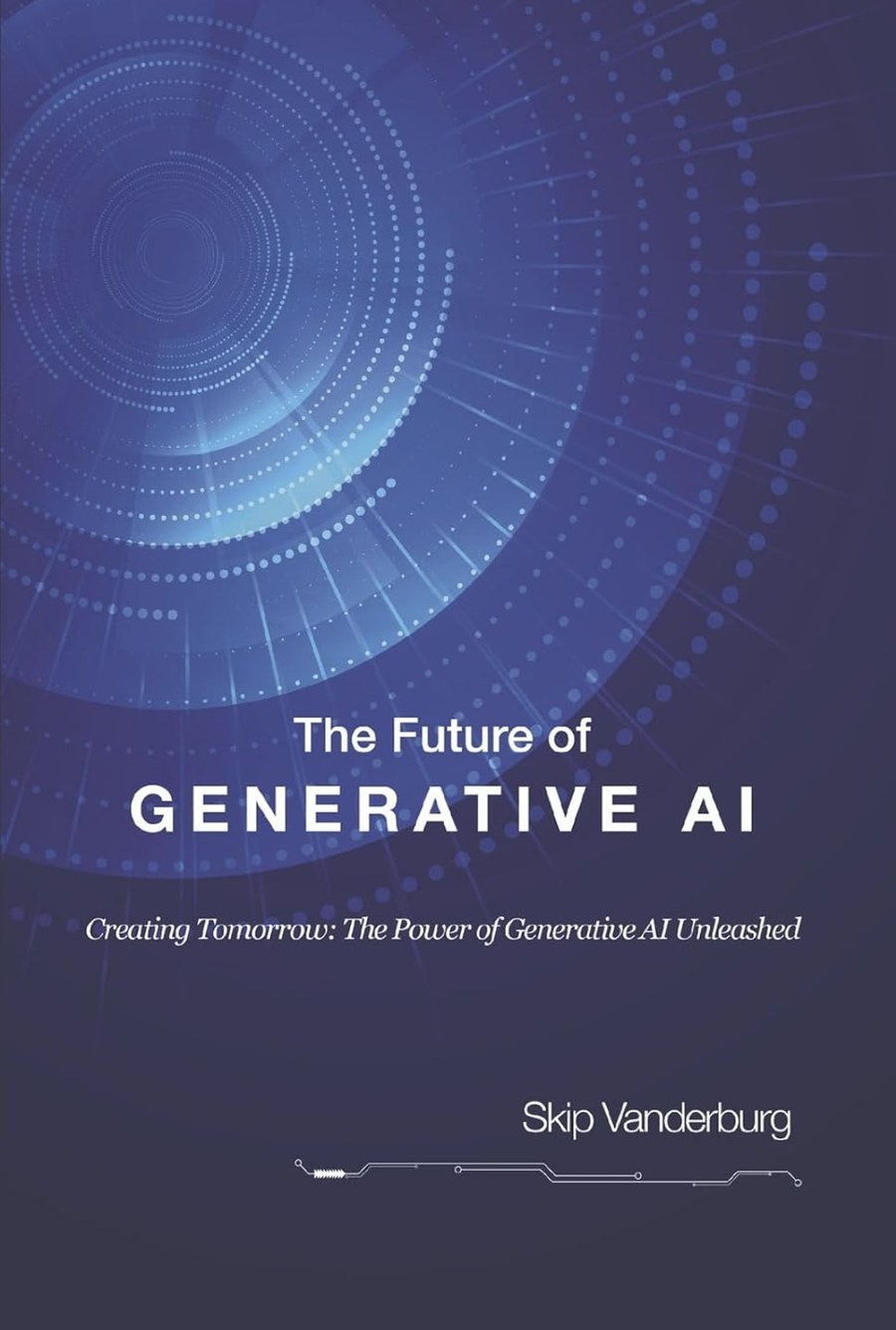
Creating tomorrow: the power of generative AI unleashed.
Unlike traditional AI, which typically processes and analyzes data to provide insights, generative AI creates — whether it’s text, images, music, designs, or even entirely new ideas. From the introduction
The distinction the book is built on: systems that analyze versus systems that produce. It traces generative AI’s capabilities, its impact sector by sector, the ethical questions, and the road ahead.
The lineage runs long. Turing’s 1950 test and the rule-based systems after it; neural networks resurfacing in the 1980s against hardware limits; the 1990s shift to machine learning and deep learning; then the decade that made generation possible — variational autoencoders in 2013, generative adversarial networks in 2014, and the 2017 transformer that made large-scale models practical.
From the Turing Test and symbolic reasoning to neural networks and the machine-learning turn
VAEs in 2013, GANs in 2014, and the transformer architecture in 2017
Contextual understanding, real-time adaptation, multimodal generation, collaborative AI
Opens with What Is Generative AI? — separating systems that classify and predict from those that produce, and the architectures behind the difference: GANs, VAEs, transformers.
Chapter 4 alone runs more than a hundred pages of sector applications — insurance, high tech, healthcare, financial services, manufacturing, industrial, ESG, pharmaceuticals, retail, and oil and energy.
The platform behind the advice
Prioriti AI is the enterprise decision-intelligence platform I founded — agentic analysis and generative prioritization for executive decisions, and part of the engine behind the experience and innovation work. The same instinct runs through both: prototype it, put it in front of people, let the evidence rank it.
AI-powered prompt orchestration and decision intelligence center with multi-agent analysis, KPIs, and executive-ready briefings.
See it in the platform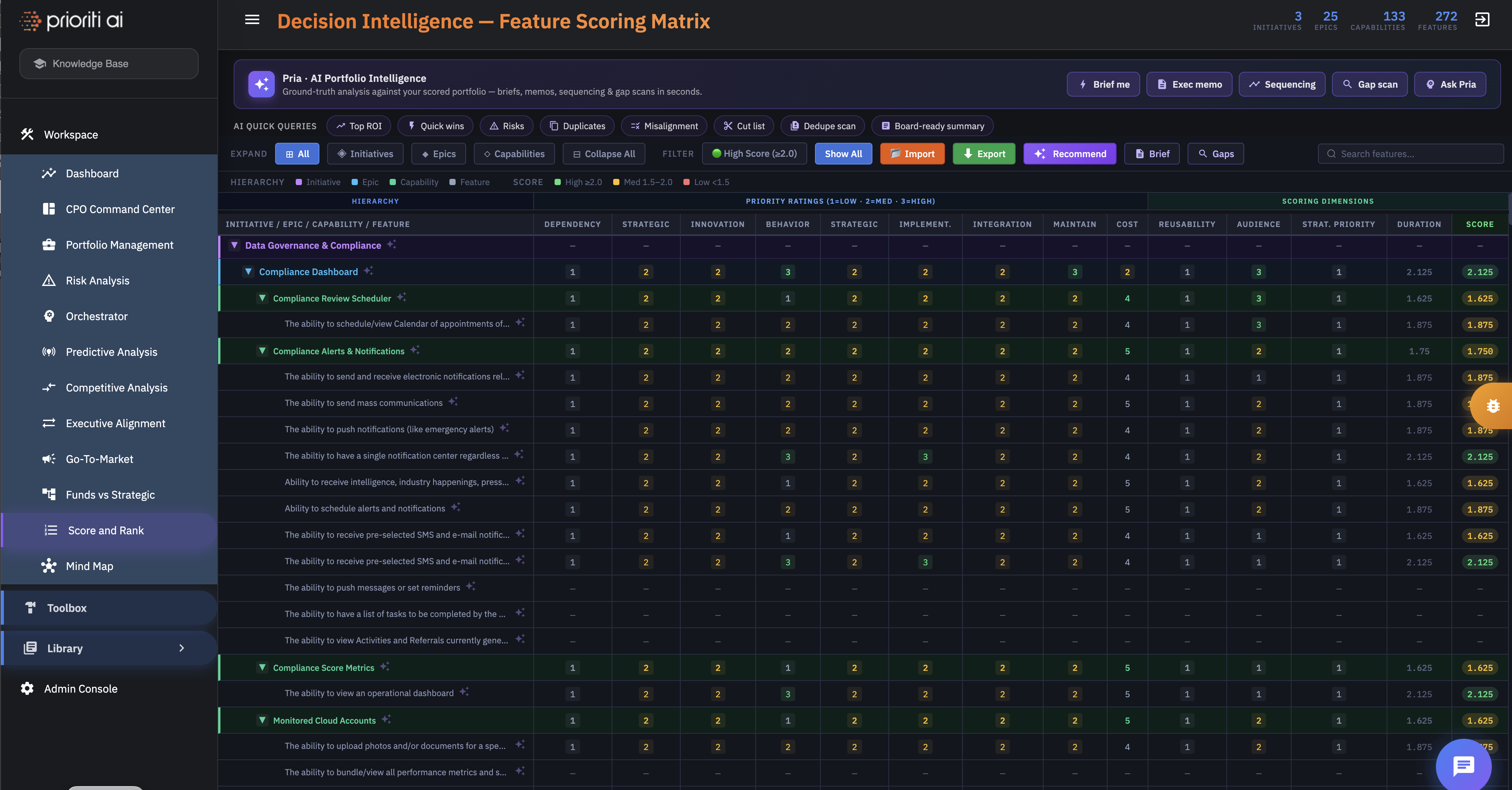
Advanced scoring and ranking with AI-powered insights to drive objective prioritization decisions across initiatives.
See it in the platform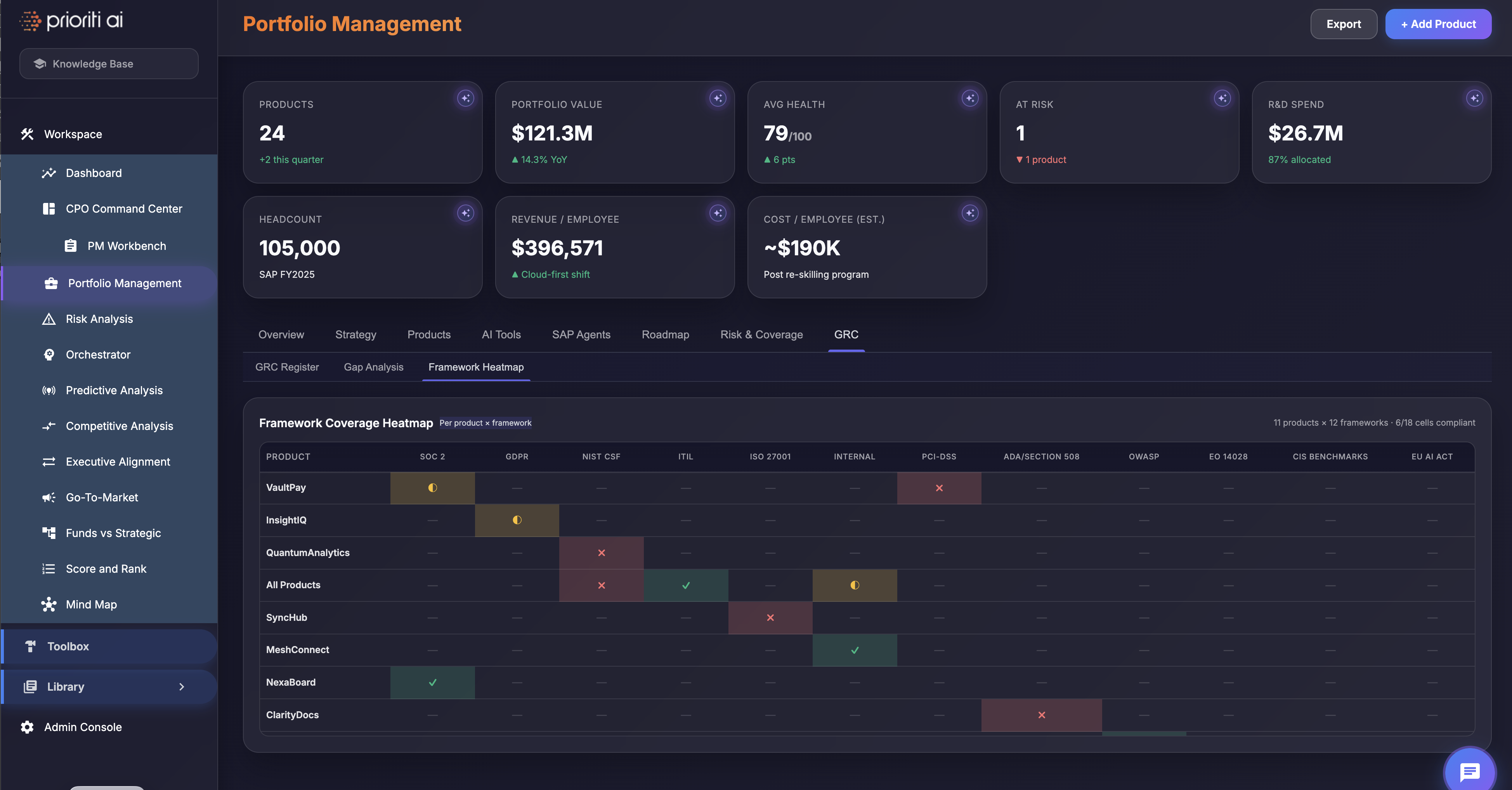
Manage and optimize your strategic portfolio with intelligent prioritization, resource allocation, and initiative tracking.
See it in the platformEvery capability in the platform — workspace, dashboards, risk, predictive and competitive analysis — is at prioriti.ai/product.html.
The other practice
The published library above is AI, because that is what got written down. The customer experience and innovation work is twenty years older and shows up as engagements, methods, and prototypes.
Engagements delivered across financial services, retail, technology, telecoms, automotive, healthcare, agriculture, and higher education — the ground this practice was built out of. Each one opens to the detail.
Journey research and mapping, service blueprinting, orchestration, experience measurement, concept prototyping and testing — the working methods, now run with AI doing the synthesis and the building.
Current-state journey research, the experience the business intends to deliver, a redesigned service blueprint, and a prototype customers have actually used — with scoping and complexity setting the timing.
The library
Books, whitepapers, articles, tools, and talks on customer experience, solution innovation, agentic AI, and decision intelligence. Filter by type or search the collection.
Contact
An experience that no longer holds up, or an innovation program stuck at the workshop stage. Bring the specific one, and we will work it in a single session.
